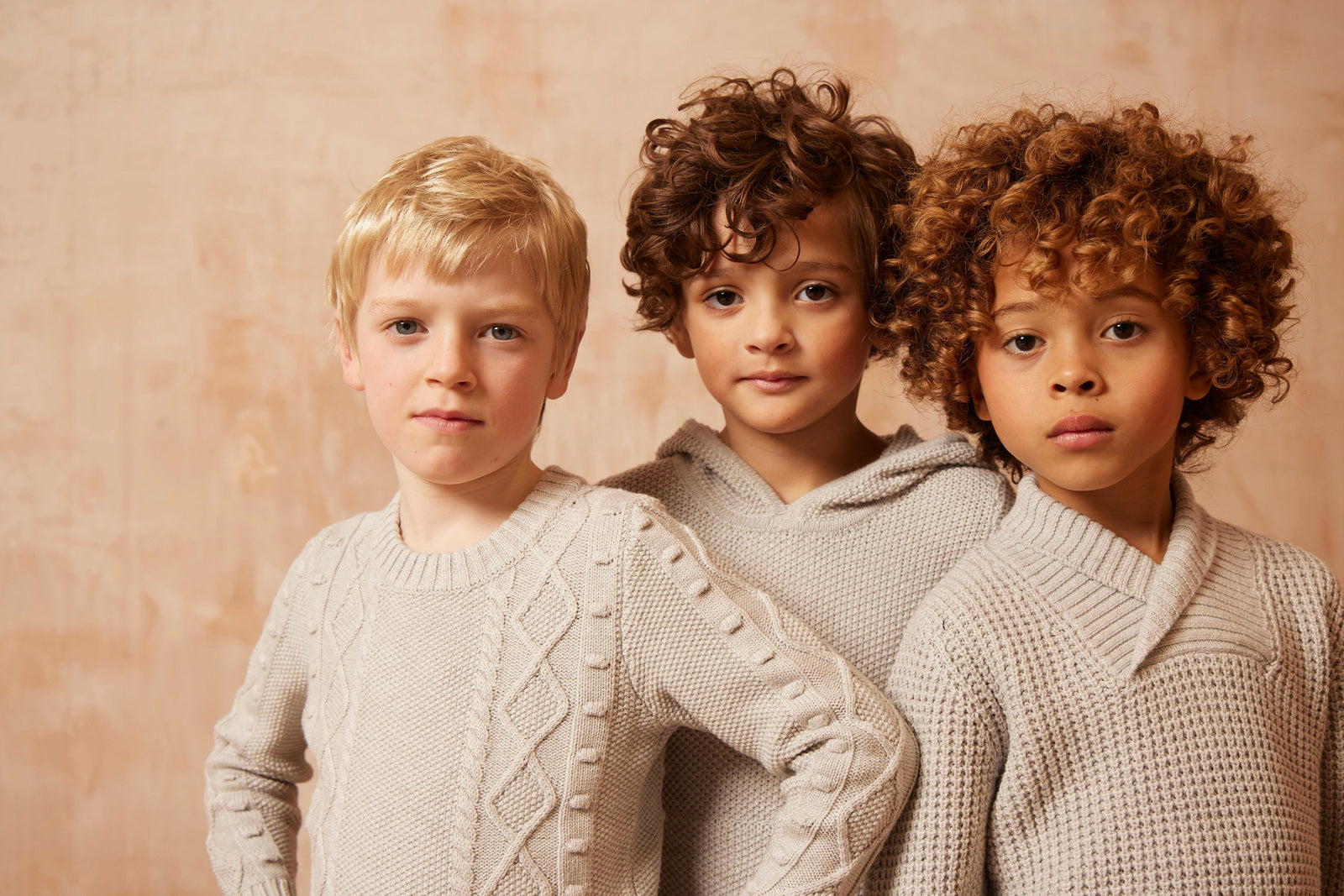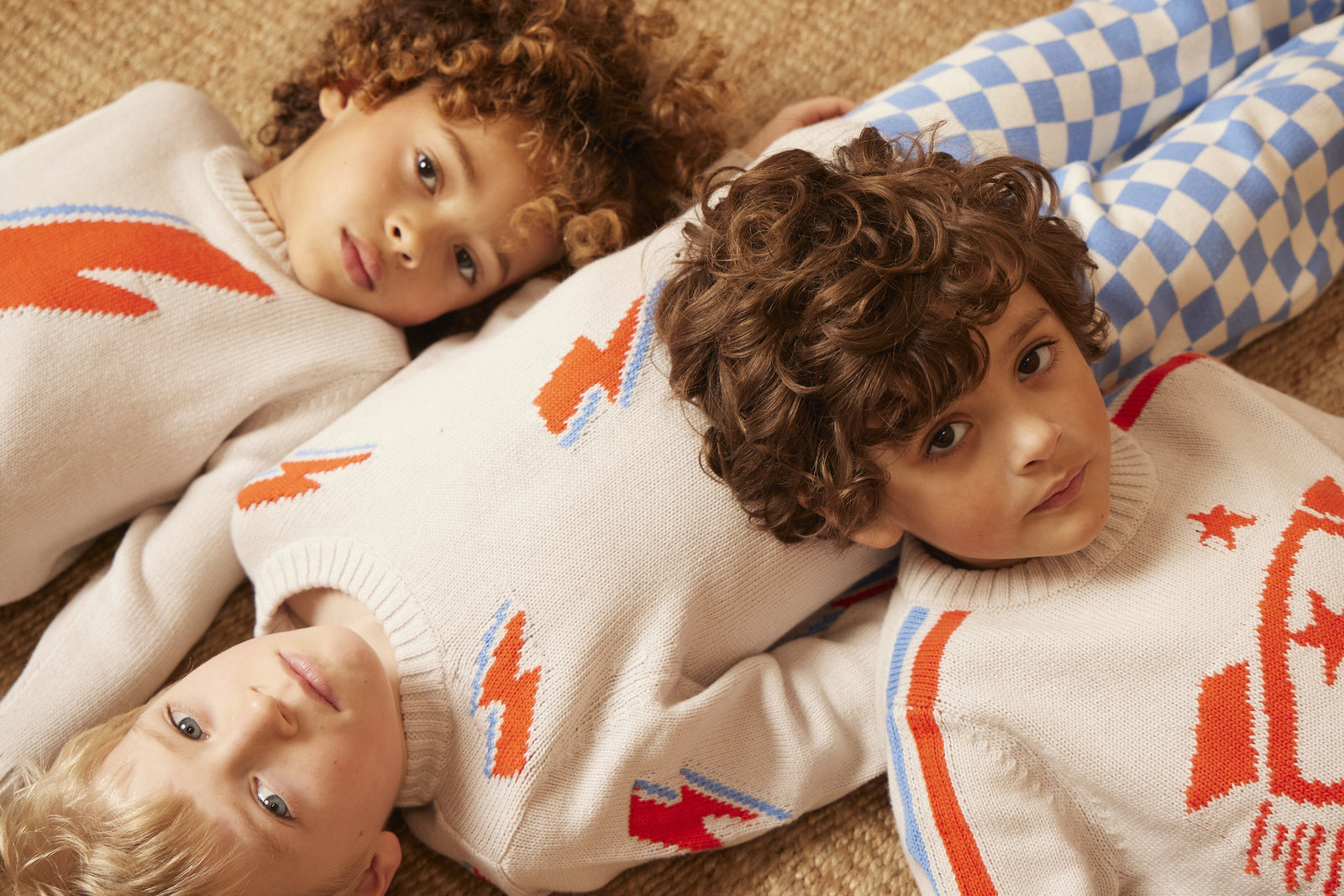

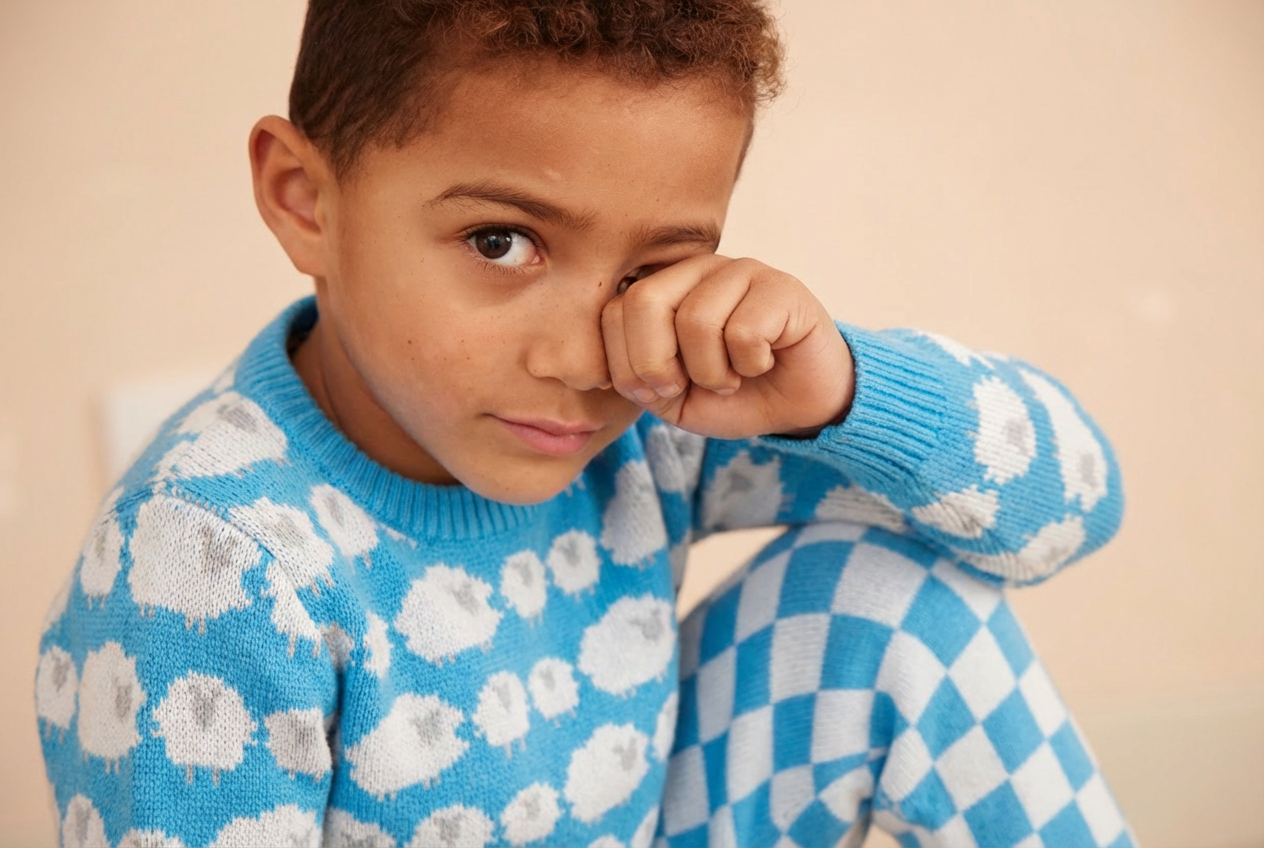

Most parents discover MIKA & MILO when they're looking for a gift. A baby shower, a christening, a first birthday — an occasion that calls for something a little better than the high street can offer. They buy a single piece and put it in a tissue-wrapped box. Then a year later, they come back and ask the question we've been waiting for: "what is this fabric, and why does it feel like nothing else?"
This is a guide to that question. Not the marketing version — the actual answer.
We make our main kids' collection from a 95% organic cotton, 5% cashmere blend. It's an unusual fabric: rare on the high street, almost unheard of in children's clothing, and easy to dismiss as a marketing flourish. It isn't. The 95/5 ratio is the most considered decision in the brand. It changes how the cloth feels, how it moves, how it ages, and how long it lasts. And it's the reason a single one of our cardigans can be worn by three children before it asks to be retired.
Here's what's in this guide:
- Why we use a 95/5 organic cotton + cashmere blend
- What that 5% of cashmere actually does
- Why GOTS-certified organic cotton matters for children's skin
- Where our cashmere comes from (and why origin matters)
- How long our pieces last
- How to care for organic cotton and cashmere kidswear
- How to choose pieces that earn their keep
- A short FAQ for the questions we hear most often
- If you're considering a piece for the first time, or trying to explain to a sceptical relative why a £80 cardigan is good value, this is the page to send them.
Why 95/5 organic cotton/cashmere
Pure cashmere is beautiful. We make some pure-cashmere pieces, mostly for the youngest babies and for accessories like our cashmere shoes and blankets. But pure cashmere wasn't built for the everyday wardrobe of a five-year-old. It needs care, it asks for a gentler life, and at the price points we'd have to charge to make it for kids, it would sit in a drawer.
A 95/5 blend solves that. Five percent of cashmere is enough — it's a lot more than it sounds — to give the cloth the soft, slightly warm hand feel that cashmere is famous for. Fibre-by-fibre, cashmere is much finer than cotton: about half the diameter of cotton on average, and far finer than sheep's wool. So even a small percentage spreads through the yarn and changes how it feels against skin.
Ninety-five percent of organic cotton is what makes the cloth tough. Cotton's strength comes from how its fibres twist around each other under tension; a kid's cardigan that has to survive being pulled, stretched, sat on, and (occasionally) wiped on a goalpost owes its life to the cotton. The cashmere couldn't do this on its own.
The result is a fabric that feels like cashmere, behaves like cotton, washes like cotton, and lasts like neither does on its own.
This is why we made the blend our main kids' collection. Not because it's a clever marketing answer, but because it's the only honest answer to "what would I dress my child in if I wanted them comfortable, looked after, and not pulling at a scratchy collar by 10am?"
What 5% of cashmere actually does
It's a fair question to ask whether 5% of anything can really matter. With cashmere, it does — for three reasons.
Softness, immediately
Cashmere fibres are between 14 and 17 microns in diameter. For comparison, the standard threshold below which a fibre is considered "non-itch" is around 22 microns. Cashmere is comfortably below that line, which is why it doesn't trigger the prickle reflex that some sheep's wool does. Even at 5%, the cashmere fibres sit on the surface of the cloth where your skin meets it. That contact point is where the softness lives.
Warmth, without weight
Cashmere insulates more efficiently than wool by weight, because the fibres are crimped — they trap pockets of warm air. A cardigan in our 95/5 blend keeps a child warmer than a pure-cotton equivalent of the same weight without becoming heavy or stiff.
A gentler drape
Pure cotton can feel a little flat and structured. The cashmere softens the way the fabric falls — it makes a jumper drape rather than hang. You see it most in our cardigans and dresses; the silhouette is closer to a fine knit than a sweatshirt.
There's also a fourth, less measurable thing: children notice. A child who finds her cotton-only school jumper itchy at the neck will keep her cashmere-blend cardigan on all day. We didn't design for that — we designed for fibre quality — but it's the observation parents share with us most often.
Why GOTS-certified organic cotton matters
Conventional cotton is one of the most chemically intensive crops on the planet. It accounts for roughly 16% of all insecticide use globally, on around 2.5% of cultivated land. For adult clothes, this is mostly an environmental concern. For children — particularly babies, whose skin is more permeable, and toddlers, who put cuffs in their mouths — it becomes a personal one too.
GOTS (the Global Organic Textile Standard) is the most rigorous textile certification we know of. It certifies the entire supply chain, from how the cotton is grown to how it's spun, dyed, and finished. To carry the GOTS mark, a fabric has to:
- Use cotton grown without synthetic pesticides, herbicides, or GM seed
- Use only low-impact dyes that meet strict toxicity and biodegradability tests
- Process the fibre without chlorine bleach or formaldehyde
- Meet social criteria across the supply chain (no forced or child labour, fair pay, safe working conditions)
For a piece of clothing that's going to spend twelve hours a day against your child's skin, this isn't a nice-to-have. It's the floor.
We use GOTS-certified organic cotton for the 95% of every piece in our main kids' collection. Our dyes are eco-certified and tested for the same standards. There are no chemical softeners — the softness comes from the fibre, not a finishing wash that fades after three cycles.
Where our cashmere comes from
The world's best cashmere comes from Inner Mongolia. The combs are run through the goats' soft undercoat in early spring, after they've grown a winter's worth of fine fibre to survive the high-plateau cold. The temperature swing — from −30°C in winter to over 35°C in summer — is what produces the long, fine fibres that make Inner Mongolian cashmere uniquely soft and durable.
Our cashmere comes from this region, sourced through a partnership we've maintained for years with the spinners and herders who do this work. The fibre is hand-combed (not sheared, which damages the staple length), sorted by hand, and spun on the same finishing equipment as fine adult cashmere.
Origin matters. A "cashmere" jumper sold in a high-street shop for £30 is unlikely to be cashmere in the way the same word means in our cloth. It might be a coarser fibre, or a shorter staple length, or a recycled cashmere blend. None of these are villainous, but they aren't what we mean when we say cashmere. The 5% in our blend is the same long-staple, hand-combed fibre that adult heritage cashmere brands have been buying for decades.
How long our pieces last
The honest answer: longer than you'd expect, and longer than the high street is built for.
A MIKA & MILO cardigan, washed at the right temperature in a mesh bag, retains its shape, softness, and colour through several years of weekly wear. We've seen pieces returned to us by customers — for repair, or just for us to admire — that have been through three children and ten years and still look like they have another generation in them.
There are three reasons our pieces last:
- The fibre. Long-staple organic cotton plus hand-combed cashmere holds together under stress in a way that short-staple, machine-blended fibres don't.
- The construction. We use full-fashion knitting, which shapes the garment on the machine rather than cutting and sewing it from a flat panel. That eliminates the seams where most knitwear fails first.
- The finish. No chemical softener to wash out. No glued trims. No fast-fashion compromises in the stitching.
The 95/5 blend was chosen partly for this. Pure cashmere fails — gently, but it fails — under the kind of treatment a child's wardrobe receives. The blend has the resilience of cotton with the comfort of cashmere. It's the most durable fabric we know how to make for this age group.
You can see how we apply this thinking to specific pieces in the Materials page and across the main kids' collection
How to care for organic cotton and cashmere knitwear
We have a full care guide. The short version is short:
- Cool wash, gentle cycle, mesh bag, gentle non-bio detergent
- Reshape and lay flat to dry — never tumble dry
- Store folded (never hang) between sizes, in a breathable cotton bag
- A cashmere comb — not a razor — for any pilling
We deliberately designed the 95/5 blend to be machine-washable. Pure cashmere can be machine-washed too, but it asks for more attention. The blend forgives the realistic life of a kids' wardrobe — porridge, paint, a forgotten pocketful of Lego.
How to choose pieces that earn their keep
If you're buying your first MIKA & MILO piece, here's how we'd think about it:
Start with a cardigan or a jumper. They're the workhorses. They go over leggings, dresses, school polos, and pyjamas. They get worn three or four times a week in the cold months. They're the pieces most likely to be passed down.
Size up, not down. Our cuts have a small amount of growing-room built in (longer cuffs, a slightly generous body) so a cardigan in age 3 can comfortably last from age 2 well into age 4. Buying ahead is rational, not extravagant — it usually adds a year of wear.
Choose colours that don't date. Our colour palette is built deliberately around tones that survive a sibling hand-down. They aren't chosen for the season; they're chosen to survive the passage of time.
If it's a gift — go pure cashmere for the youngest. Our cashmere shoes, cashmere blankets, and cashmere baby pants are all-cashmere because the youngest babies wear pieces fewer times before outgrowing them. Pure cashmere is the right material for a piece that will be worn for six months and then become a keepsake. The 95/5 blend is the right choice once a child is old enough to actually live in their clothes.
Frequently asked questions
Is 5% cashmere really enough to make a difference?
Yes. Cashmere fibres are very fine (14–19 microns), so 5% of the yarn weight is more like 8–10% of the surface area touching skin. The softness is in the contact point.
Is the 95/5 blend warm enough for winter?
Layered, yes. A 95/5 cardigan over a long-sleeve top is comfortable for British winters indoors and most school playgrounds. For deep cold, our pure-cashmere accessories — hats, scarves, socks — add a lot of insulation for very little weight.
Can I machine-wash it?
Yes. Cool, gentle cycle, mesh bag, non-bio detergent. Lay flat to dry. See our full care guide for detail.
Is the cashmere ethical?
Our cashmere is hand-combed (not sheared) from Inner Mongolian herds, sourced through a long-standing partnership. The fibre is processed and spun under certified standards. We are not perfect — no luxury fibre is — but we're more transparent about it than most. Read our materials story for more.
Why is it more expensive than high-street kids' clothes?
Because GOTS-certified organic cotton costs more than conventional cotton, hand-combed Inner Mongolian cashmere costs more than recycled or short-staple cashmere, full-fashion knitting costs more than cut-and-sew, and certified low-impact dyes cost more than standard dyes. Each of those is a deliberate choice, and each is what makes a piece last long enough to be worn by three children.
What ages do you make this collection for?
The 95/5 blend kids' collection runs from around 1 year to 10 years.
Will my child outgrow it before it wears out?
Almost certainly. That's why we design for hand-down. The colours, the cuts, and the fabric are all chosen to look just as good on the second child as the first.
What to do next
If you're new to MIKA & MILO, the easiest place to start is a single piece — a cardigan, a or one of our cashmere baby gifts if you're shopping for someone else. Once you feel the cloth, the rest of this guide will have made more sense than any number of words can.
Browse the kids' collection