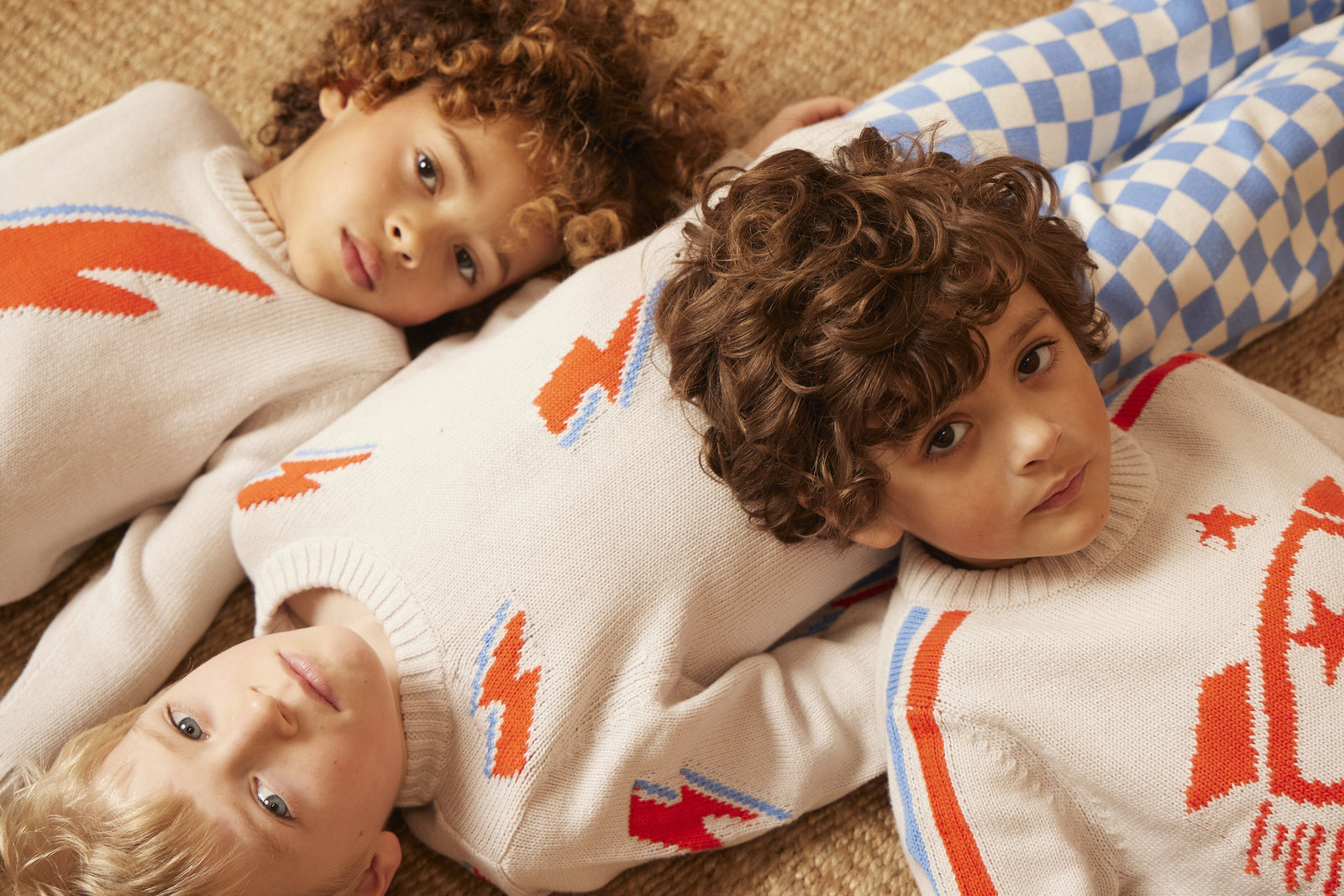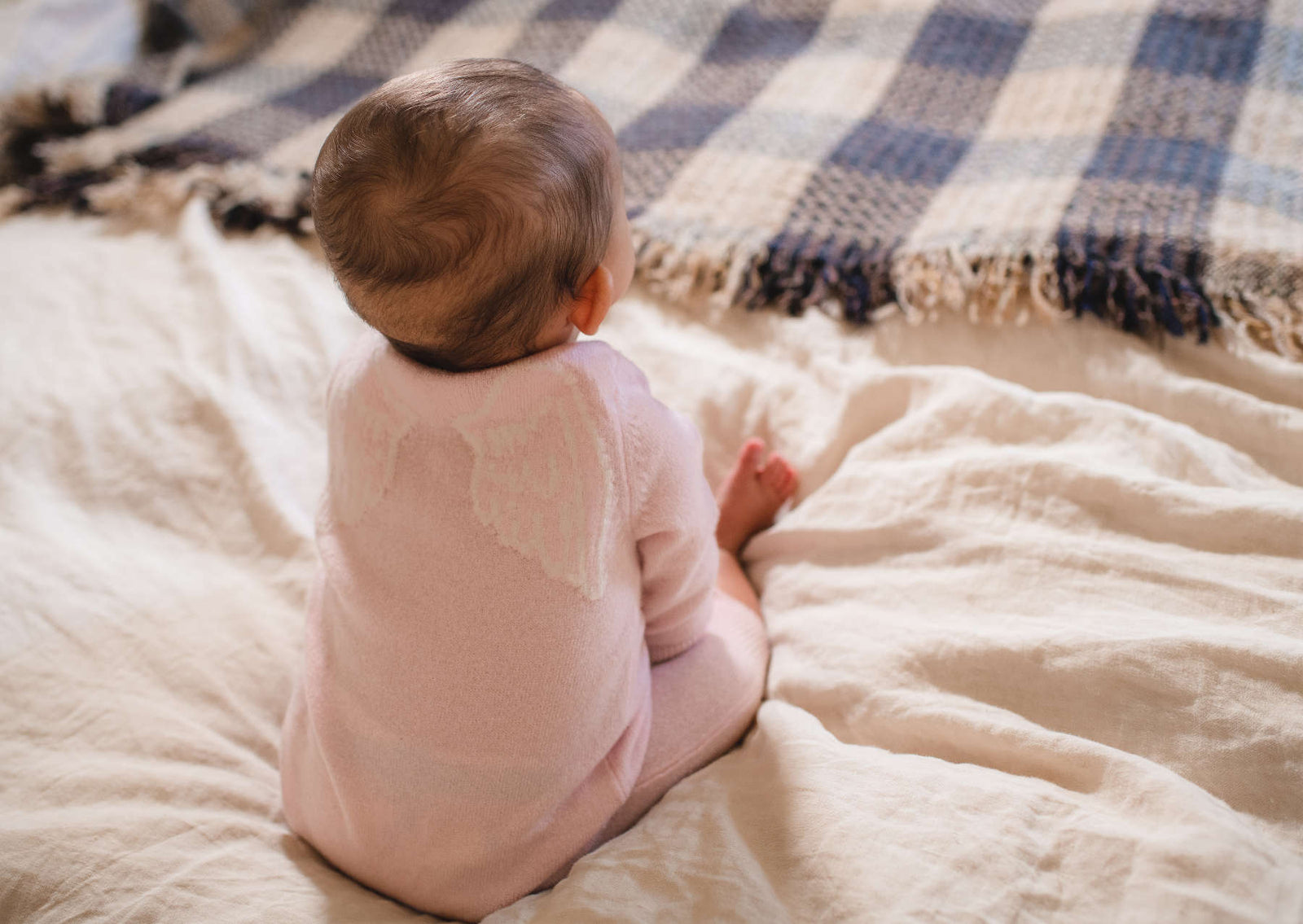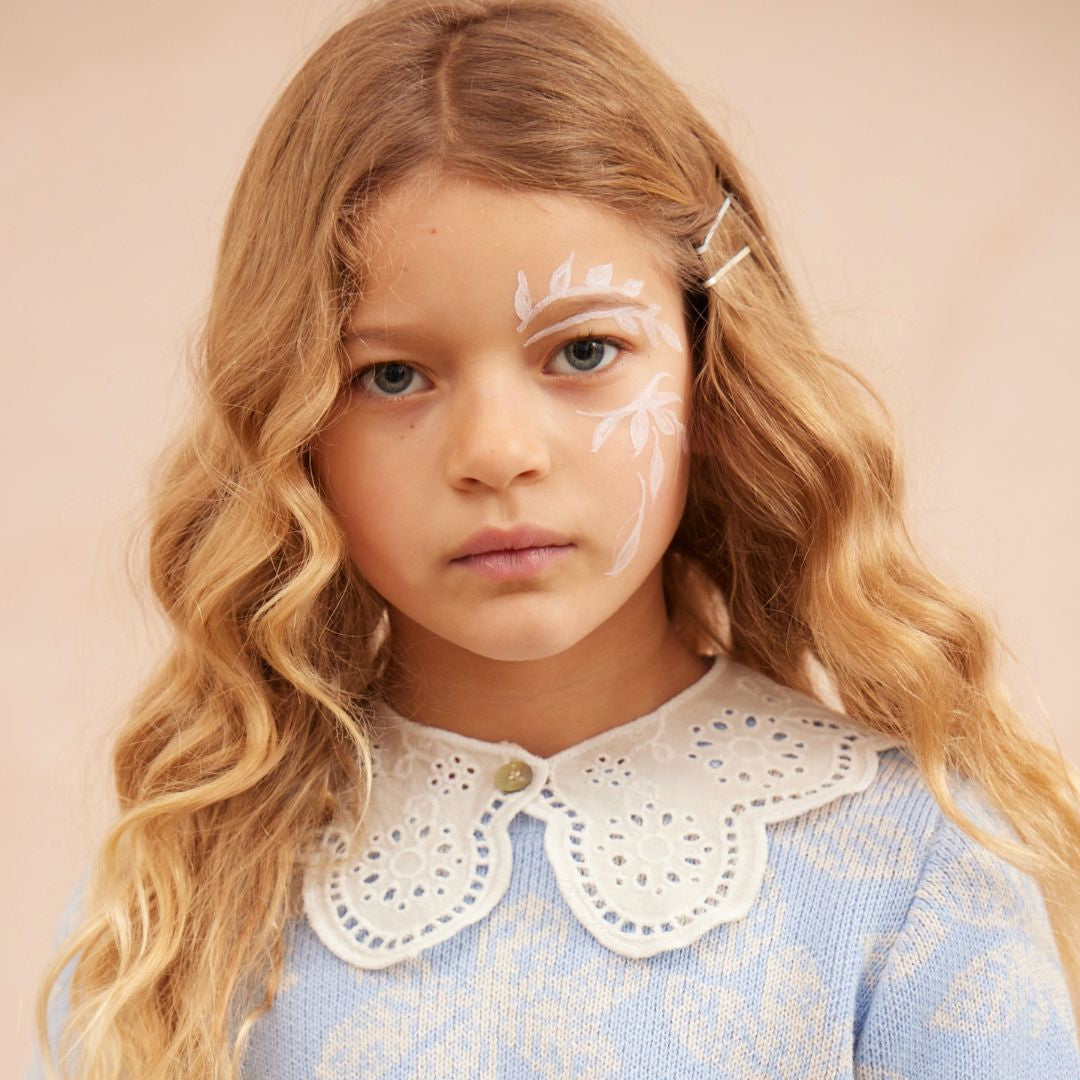


If you have a child who pulls at the collar of every jumper, who comes home with red patches on the inside of their elbows, or who refuses to wear "scratchy" clothes — this post is for you.
Most fabric-related skin trouble in childhood comes down to two things: the fibre itself, and what's been done to it on the way to becoming cloth. The fabric we use for our main kids' collection — a 95% GOTS-certified organic cotton, 5% Inner Mongolian cashmere blend — is built to address both.
Here's what's in this post:
- The science of "itchy"
- Why cashmere doesn't itch
- Why GOTS-certified organic cotton matters for sensitive skin
- What we leave out (and why that matters more than what's in)
- Eczema, atopic skin, and what we can and can't say
- A short FAQ
If you'd like the full picture of how the fabric is constructed, see our main kids' guide.This post is specifically about skin.
The science of "itchy"
Textile researchers have known for decades that the prickle reflex — the involuntary scratch when you put on a wool jumper — has very little to do with allergy. It's mechanical. The cause is the diameter of the individual fibres pressing into the skin.
The threshold is well established at around 22 microns. Below 22 microns, fibres bend when they touch the skin and the prickle reflex doesn't fire. Above 22 microns, the fibres press into nerve endings and trigger the sensation we describe as itch.
Most coarse sheep's wool is between 25 and 35 microns. That's why the school jumper from a fast-fashion shop is itchy. The fibre diameter has nothing to do with the marketing language on the label.
Cashmere is between 14 and 19 microns — comfortably below the prickle threshold. Cotton is between 12 and 20 microns depending on staple length. Both fall in the non-itch range, which is why a 95% organic cotton, 5% cashmere blend is one of the most consistently comfortable fabrics you can put a sensitive child in.
This isn't a marketing claim. It's micron measurement.
Why cashmere doesn't itch — even at 5%
The 5% cashmere in our main kids' collection sits on the surface of the cloth, where the soft fibres bloom out from the yarn. Because cashmere is so much finer than cotton — about 30% finer on average — those 5% of fibres punch above their weight in terms of skin contact.
It's also why cashmere is one of the few "wool family" fibres that is consistently described as soft rather than scratchy. Sheep's wool, alpaca, and most other animal fibres average above the 22-micron prickle threshold. Cashmere, in its finer grades, is below it. The fibre is biologically engineered for a goat that survives temperatures of −30°C in Inner Mongolia: it has to be fine, soft, and warm in equal measure.
For children with sensitivity, the practical effect is that a MIKA & MILO 95/5 cardigan reads to the body as soft cotton, with a touch more lift, warmth, and "give" than pure cotton offers. The cashmere doesn't shout — it just makes the cotton kinder.
Why GOTS-certified organic cotton matters
The fibre is half the story. The other half is what's been done to it.
Conventional cotton is one of the most chemically intensive crops on the planet. It accounts for roughly 16% of global insecticide use on around 2.5% of cultivated land. After harvest, conventional cotton is typically processed with chlorine bleach, formaldehyde, and a string of finishing chemicals that — for adults wearing pieces a few hours a day — usually pose minimal personal risk.
For children, who wear cotton for twelve hours a day, sleep in it, and (in toddlerhood) often chew on it, the calculus shifts.
GOTS — the Global Organic Textile Standard — is the most rigorous textile certification we know of. It certifies the entire chain:
- Cotton grown without synthetic pesticides, herbicides, or GM seed
- Processing without chlorine bleach, formaldehyde, or heavy metals in dyes
- Dyes that meet strict toxicity, biodegradability, and skin-contact tests
- Social criteria across the supply chain (no forced labour, no child labour, fair pay, safe conditions)
We use GOTS-certified organic cotton for the 95% of every piece in our main kids' collection. This is what allows us to say, without hedging, that our clothes are appropriate for the most sensitive skin.
What we leave out
Sometimes what isn't in a fabric matters more than what is.
No chemical softeners. Most high-street cotton is treated with a softening finish that washes out within five to ten cycles. The cloth then becomes harsh — which is why fast-fashion kids' clothes feel less soft after a month than they did in the shop. Our softness comes from the fibre itself, not a finish, so it doesn't fade.
No formaldehyde resins.Used in many "wrinkle-free" finishes; banned under GOTS.
No chlorine bleach. Replaced with hydrogen peroxide in our processing.
No nickel buttons.A common cause of contact dermatitis on kids' jumper plackets. Our buttons are corozo (a plant-based natural button material) or covered.
No glued trims. Heat-pressed glues are often where cheap kidswear sheds microplastics and where skin reactions originate. We sew, we don't glue.
This is the second half of why our pieces are gentle. The fibre choice gets you below the prickle threshold; the GOTS chain gets you free of the irritants that compound on top of fibre.
Eczema, atopic skin, and what we can and can't say
We are extremely careful here. Eczema and atopic dermatitis are medical conditions, and we cannot — and won't — claim that any garment treats or prevents them.
What we can say is this:
- The most common dermatologist-recommended fabric advice for atopic skin is to avoid coarse wools, synthetic fibres, and chemically processed cotton in favour of soft, breathable, untreated natural fibres.
- Many of the parents who have been with us longest came to us because their child reacted to fast-fashion school uniforms, polyester sleepwear, or scratchy hand-me-downs.
- The 95% GOTS-organic-cotton, 5% cashmere blend ticks the boxes that this advice tends to consist of.
If your child has diagnosed eczema, the right answer is always to ask your GP or paediatric dermatologist. We're a clothing brand, not a medical authority. But we're a clothing brand that designed the fabric for exactly the kinds of skin sensitivities we've heard about for years from our customers.
What about wool allergies?
True wool allergy — an immune reaction to lanolin, the natural oil in sheep's wool — is rare. Most "wool allergies" are actually wool sensitivity: the prickle reflex from coarse fibre, mistaken for an allergic response.
Cashmere is a goat fibre, not a sheep fibre. It contains no lanolin. Children with diagnosed lanolin sensitivity are almost always able to wear cashmere without issue. (As ever — if there's a confirmed allergy, ask your dermatologist before assuming.)
Frequently asked questions
Is your kidswear suitable for sensitive skin?
Our 95/5 organic cotton and cashmere blend is among the gentlest fabrics a child can wear. The fibres are below the textile prickle threshold, the cotton is GOTS-certified organic, and our processing avoids the chemicals most often linked to skin reactions in children's clothing.
Is cashmere itchy?
Quality cashmere is not itchy. Cashmere fibres are between 14 and 19 microns, well below the 22-micron prickle threshold. Coarse cashmere from cheaper supply chains can sit closer to the threshold, which is why fibre quality matters.
Is cashmere safe for children with eczema?
Many parents find soft, fine fibres like cashmere and organic cotton are well tolerated. We can't make medical claims; please consult a paediatric dermatologist for diagnosed conditions. Our blend is designed to align with the standard fabric advice for atopic skin: soft, breathable, untreated natural fibres.
Is the 95/5 blend hypoallergenic?
We avoid the word "hypoallergenic" because it has no regulated meaning in textiles. What we can say is: cashmere contains no lanolin, GOTS-certified organic cotton avoids the irritants common in conventional cotton processing, and our finishing avoids formaldehyde, chlorine bleach, and nickel.
Will my child react to cashmere if they have a wool allergy?
Usually not. Cashmere is a goat fibre and contains no lanolin, the oil that triggers most "wool" allergic reactions. If there's a diagnosed allergy, ask your dermatologist before wearing.
What dyes do you use?
Eco-certified low-impact dyes that meet GOTS standards for toxicity, biodegradability, and skin-contact safety. No heavy metals. No azo dyes that release banned amines.
What to do next
If your child has been pulling at every jumper they own, the easiest test is one piece. Most parents tell us they know within an hour of putting it on — the child stops fidgeting and forgets they're wearing it.
Shop kids'organic cotton & cashmere
For the materials story in more depth, see whywe love organic cotton and cashmere