

Some objects pass between generations and some don't. A wedding ring does. A first edition does. A cashmere cardigan, in theory, doesn't — kids' clothes have been treated, for the last twenty years or so, as something closer to disposable than enduring. Bought cheap. Outgrown. Bagged up. Sent to landfill or, with luck, to a charity that ships them to be sold by weight in another country.
We started MIKA & MILO partly because the maths of that didn't work for us. A child's wardrobe is one of the largest sources of textile waste in a household, and almost none of it is necessary. The pieces don't wear out. They're outgrown long before they fail. Which means a single piece, made well, can outlast the first child by years.
This is a piece about that — about the maths, the mindset, and the actual, practical question of what a piece of clothing has to be to survive a hand-down. It also happens to be the question we've spent twenty years answering.
How baby clothes became disposable
The kids' clothing market wasn't always like this. A generation ago — the generation that gave us our family textile mill, four generations back — children's clothes were made well, repaired, and passed between siblings as standard. Hand-me-downs were not a sign of poverty. They were how childhood worked.
Three things changed that:
1. The cost of children's clothes collapsed. Fast fashion arrived in the 1990s and reset the price expectation for kidswear. A T-shirt for £2.50 isn't built to be passed down. It isn't built to last a year.
2. The aesthetic shifted. Slogan T-shirts, novelty prints, character licensing — clothes designed to be cute *now*, not photographed in five years. A shark-printed onesie ages out of charm fast.
3. The volume of stuff increased. Parents were given vastly more pieces than they needed. The gift drawer overflowed. Each piece got worn fewer times. Quality became less relevant when nothing was worn enough to test it.
The result is what we now call "kids' fashion": a category of clothing where £20 billion is spent annually in the UK alone, and more than two-thirds of it ends up in landfill within two years.
We're a small brand. We won't fix this. But we make our pieces in a way that proves it doesn't have to be like this.
The maths of buying once
A typical fast-fashion kids' cardigan, washed and worn weekly, lasts maybe twelve months before the cuffs go, the elbows thin, or the colour fades enough that the next sibling won't want to wear it. A child between 1 and 12 will go through, by our rough count, around fifteen cardigans in that span if they wear them seasonally.
Fifteen cardigans, at — let's be generous — £15 each, is £225 per child.
Three children: £675 across the family. Forty-five cardigans into landfill or the back of the charity bag.
Compare that to one MIKA & MILO 95/5 organic cotton and cashmere cardigan, which we expect to last comfortably through three children with appropriate care. Even at £130, that's £130 across three children — £43 per child — and one cardigan in the textile economy instead of forty-five.
The maths aren't a marketing trick. They're a category-shift in how children's clothes are made and used. The reason fast fashion looks cheaper at first glance is because it's externalising the cost — to the planet, to the next charity bag, to the next landfill, to the worker on £40 a month.
The proper-cost-per-wear of a heirloom-quality piece is, in nearly every case, lower than the proper-cost-per-wear of fast fashion.
What a piece of clothing has to be to survive a hand-down
This is the operating question for everything we make.
To survive being passed from one child to the next, a piece has to clear four bars:
1. The fibre has to be good enough not to wear out. Long-staple organic cotton with a small percentage of fine cashmere (our 95/5 blend) outlasts conventional cotton by years. The fibre length is what determines whether the cloth pills, thins, and breaks down — short-staple cotton produces lint and wear; long-staple cotton stays smooth.
2. The construction has to be strong enough not to fail. The seams are where most knitwear breaks first. We use full-fashion knitting — the garment is shaped on the machine instead of cut and sewn from a flat panel. There are no glued joins. There are no overlocked edges to fray. The shoulder seams are reinforced by the knit structure itself.
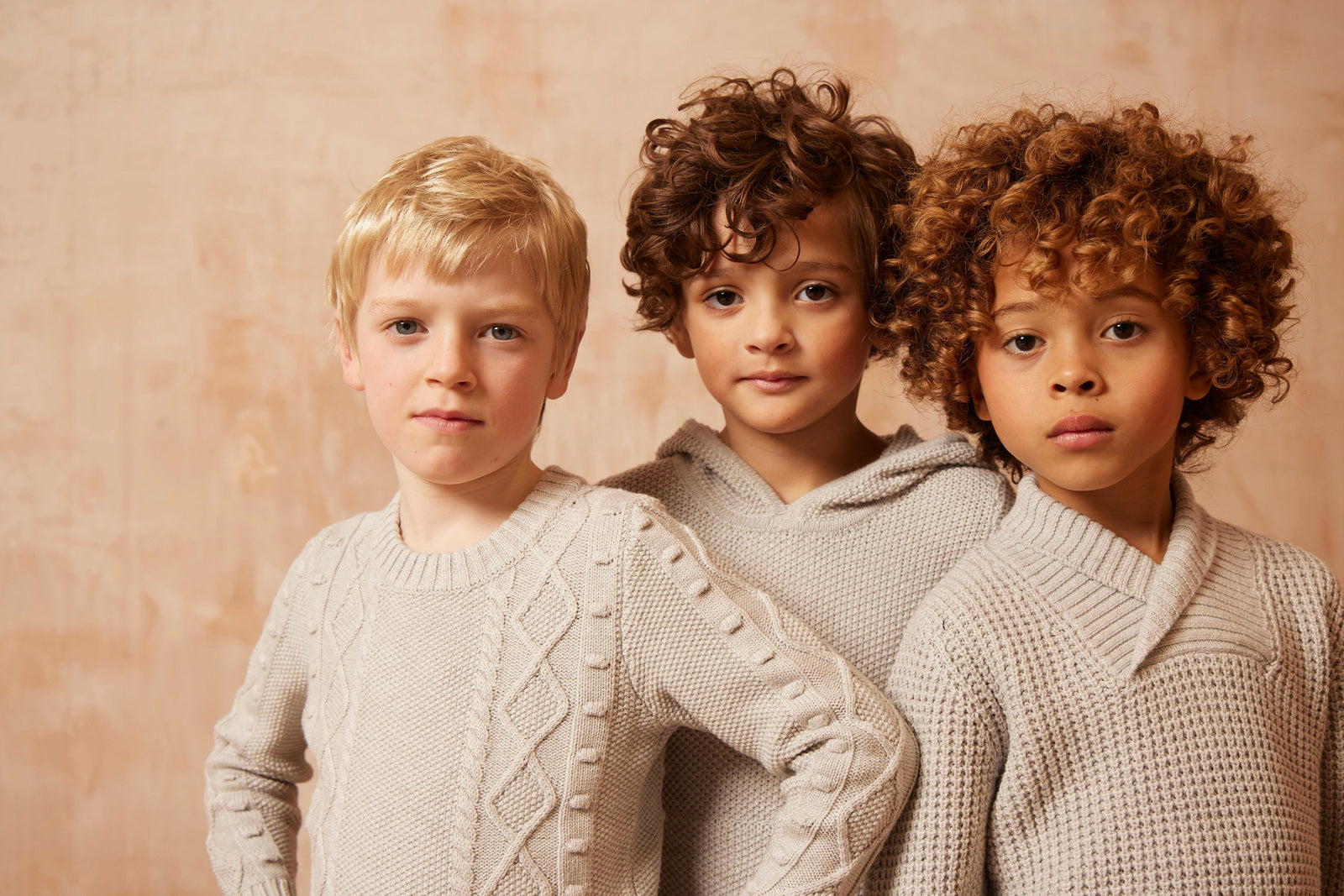
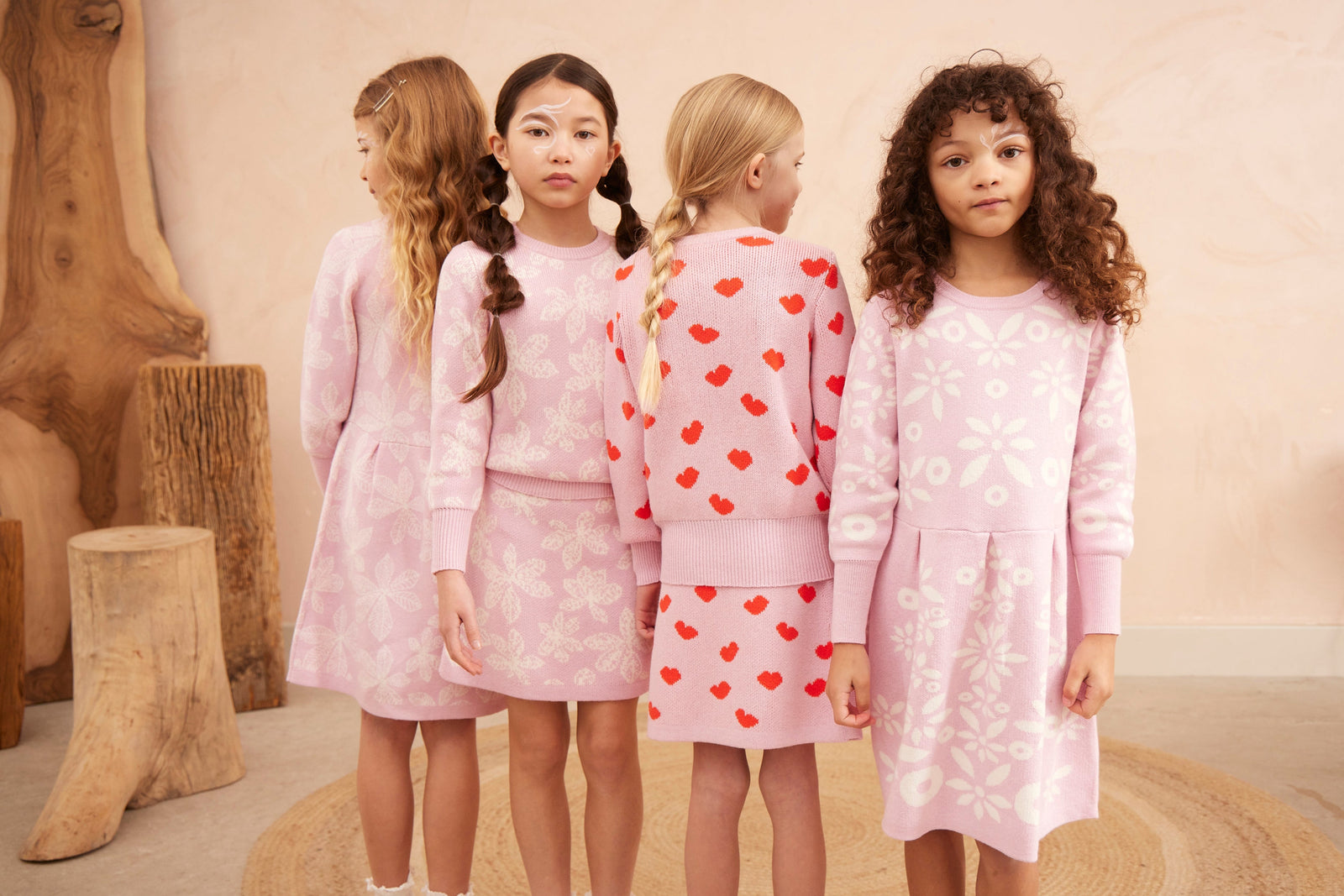
3. The colour has to age. A bright neon pink dates within two years. A soft oatmeal does not. We choose colours that look good in family photographs in 2026 and will still look good in family photographs in 2036. Soft greys, dusty pinks, deep creams, charcoal, lilac.
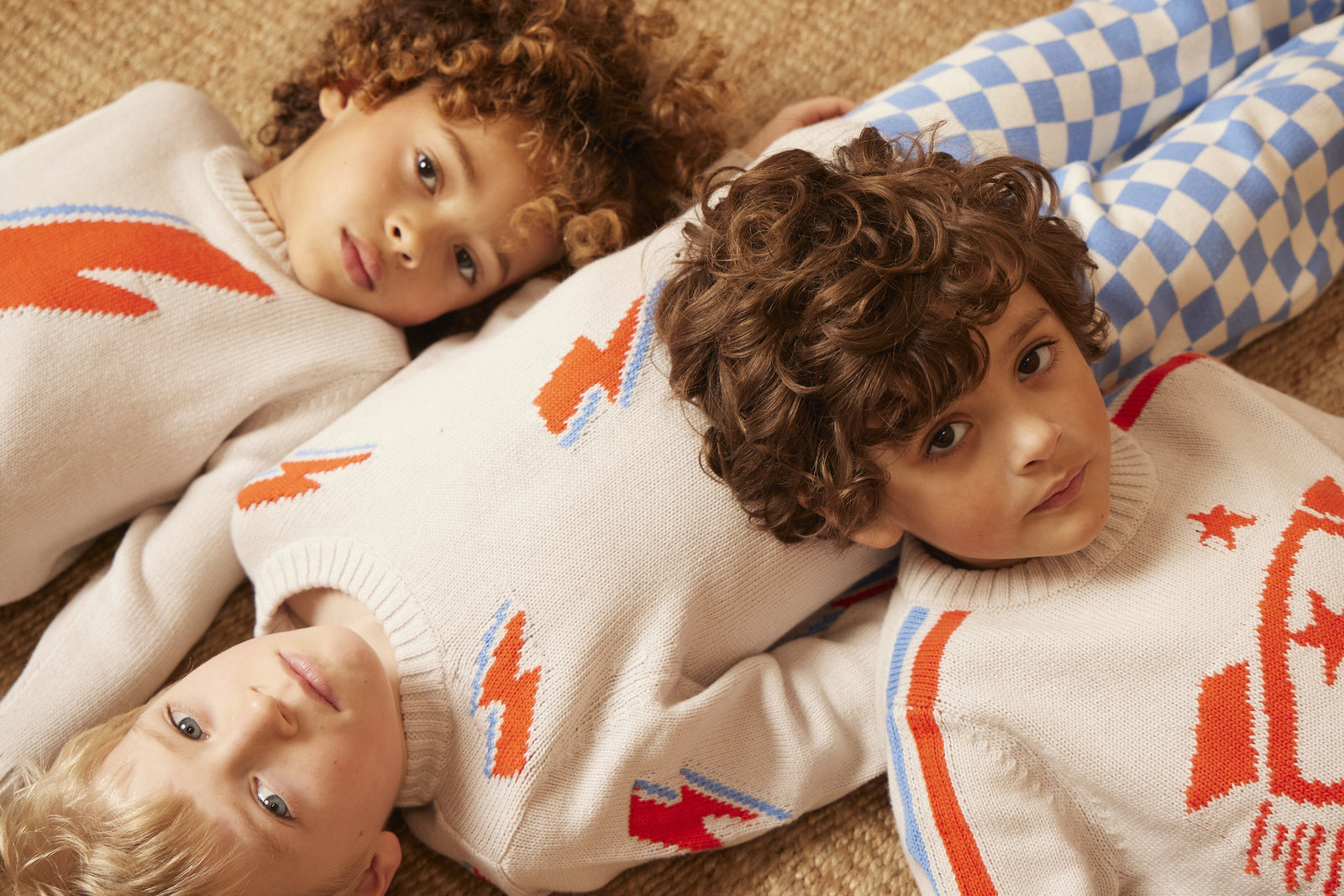
4. The aesthetic has to be quiet. No prominent logos. No slogan. No character that will be ridiculous when the child who's now wearing it is fifteen. The pieces have to be timeless because they will, with luck, be timed across a decade.
A piece that clears these four bars can live for a decade. We've seen it. We have customers who returned a cardigan for a quick repair after their third child outgrew it — and were quietly hoping there might be a fourth coming.
Care as ritual
There's a part of the heirloom calculus that's about you, not the cloth.
The decision to wash a cardigan carefully, fold it for storage, comb the pills out before the next child wears it — that ritual is partly practical and partly something else. It's an act of attention. It's the opposite of how most kids' clothes are treated. It changes how you think about what a child's wardrobe is *for*.
We hear this from customers as a small surprise of the brand. They came for the fabric. They stayed because the way the pieces ask to be cared for changed something about how they thought about the rest of their household. The Sunday-evening folding-and-storing of a 95/5 cardigan for next winter's child is, several customers have told us, one of the small good rituals of parenthood.
We're not here to romanticise laundry. But we are here to suggest that buying differently leads, almost without effort, to relating to objects differently.
The full mechanics of how to wash, dry, and store our pieces are in our [care guide](./02-care-guide.md). It's worth a read.
The cashmere question, honestly
Heirloom thinking and cashmere don't always sit easily together. Cashmere has, over the last decade, attracted legitimate criticism: overgrazing in some Mongolian regions, herd expansion driving land degradation, opaque supply chains where "Mongolian cashmere" can mean anything.
We've thought about this carefully. Our position is:
- Source matters more than fibre. Inner Mongolian cashmere from a long-standing, traceable partnership with herders and spinners is a different proposition to anonymous "cashmere" sourced through the open market.
- 5% is a deliberate choice. A 95/5 blend uses a fraction of the cashmere a pure-cashmere garment uses, while preserving most of the surface feel. It's a more responsible way to bring cashmere into a kids' wardrobe.
- Hand-down economics matter. A cashmere blend cardigan worn by three children is more responsible than three pure-cotton cardigans worn by one child each — even before you count the cashmere supply-chain question. The piece is amortised across more wear.
- Transparency is the price of using cashmere at all. We will keep telling the story of where our cashmere comes from. We won't pretend it's a perfect material. We'll say what we're doing and why.
This is the honest answer. We're a small brand, working in a fibre with real questions attached, trying to do better than the average. Heirloom-thinking is a big part of how we think it can be defensible.
Customer stories
This is, in many ways, the most important section of this essay — and the section we've left mostly blank.
We're collecting stories from customers about pieces that have been passed between siblings, between cousins, between generations. The cardigan that's now on its third child. The blanket that wrapped a baby in 2014 and a baby in 2024. The onesie that's been worn by every grandchild on one side of a family.
If you have one, we'd love to hear it. Send us a photo and a sentence about who wore the piece and when. We're building a quiet wall of these stories — a record of what kids' clothes can be when they're built to last.
Share your story to aiko @mika-milo.com
The brand mission, kept short
We make heirloom-quality kidswear because we don't believe a child's wardrobe should be disposable. Our pieces are made in a 95/5 GOTS-certified organic cotton and Inner Mongolian cashmere blend, knitted full-fashion in Inner Mongolia, in a colour palette chosen for the long view. They're built to be worn, washed, passed down, and remembered.
Frequently asked questions
How long do MIKA & MILO kidswear pieces last?
With appropriate care, our 95/5 organic cotton and cashmere pieces are built to last several years and across multiple children. We have customers whose pieces have served three siblings.
How should I store kids' clothes between sizes for the next child?
Wash and fully dry first, then fold (never hang) and store in a breathable cotton bag with a cedar block or lavender sachet. Keep cool, dry, and out of direct sunlight. See our care guide for full detail.
What's the most durable fabric for kids' clothes?
In our experience, a 95% organic cotton, 5% cashmere blend with full-fashion knit construction. The cotton handles the structural wear; the cashmere keeps the surface soft. Pure organic cotton is also very durable but loses softness more quickly.
Is cashmere ethical for children's clothing?
It depends entirely on the supply chain. We use Inner Mongolian cashmere sourced through a long-standing, traceable partnership with herders and spinners, and we use it in a 95/5 blend so each garment uses a fraction of the cashmere a pure-cashmere piece would. Transparency about where cashmere comes from matters more than the fibre itself.
How do I clean a piece for the next baby after a few years of storage?
Give it a fresh cool wash in non-bio detergent, a gentle cycle, and lay flat to dry. The cloth refreshes beautifully. Comb out any pills with a cashmere comb before the next child wears it.
What to do next
If you'd like to choose a piece that's built to be passed down — not as marketing language, but as fabric, construction, and design — start with a 95/5 [cardigan](https://mika-milo.com/collections) or [jumper](https://mika-milo.com/collections) in a soft neutral. Buy in age 2–3 and you'll see it through three winters and, with luck, three children.
Shop the kids' collection
If you have a heirloom story already, share it with us. We're collecting them.
---