
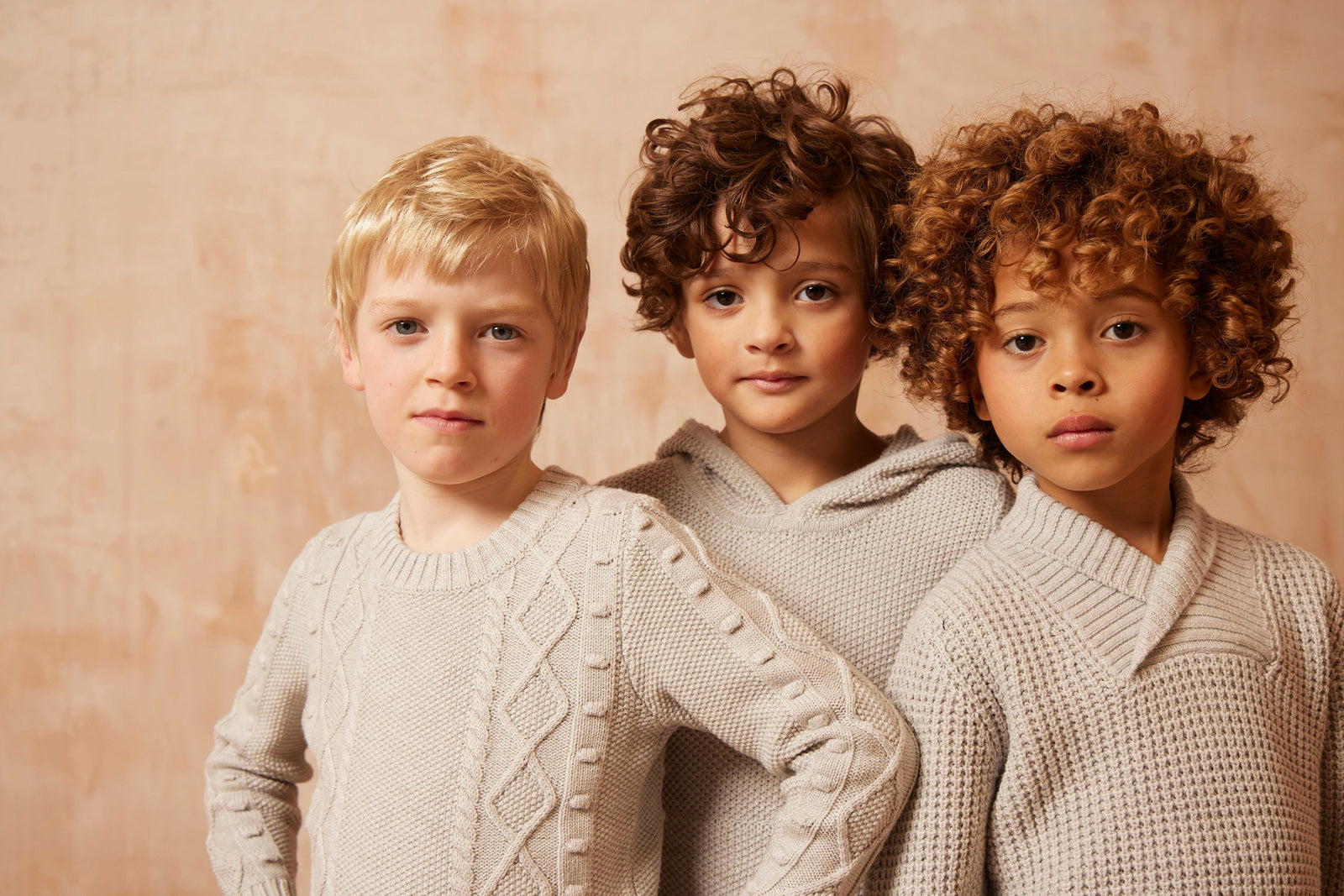

Children spend six to eight hours a day in their school clothes. That's more time than they spend in any other outfit — more than weekend clothes, more than occasion wear, more than pyjamas. The fabric they're wearing for those hours matters more than most parents consider when buying school clothing.
The Problem with Synthetic School Clothing
The majority of children's school clothing — particularly the non-uniform layers that go over or under uniform — is made from synthetic fibres. Polyester, acrylic, and nylon are cheap to produce and easy to care for, which is why they dominate the market. But for children wearing them all day, they have significant drawbacks.
Synthetic fibres don't breathe. They trap heat and moisture against the skin, creating the warm, damp conditions that cause discomfort, irritation, and in children with sensitive skin, eczema flare-ups. A child who is physically uncomfortable is a child who is distracted — and the connection between physical comfort and concentration is well-established.
Synthetic fibres also hold odours. A polyester jumper worn through a day of activity will smell by the end of it in a way that a natural fibre equivalent simply won't. This is not a minor consideration for children who are self-conscious about how they present.
What Natural Fibres Do Differently
Natural fibres — organic cotton, cashmere, merino — breathe. They allow air to circulate and moisture to escape, keeping children cooler when they're active and warmer when they're still. This temperature regulation is a physical property of the fibre structure, not a marketing claim.
Our 95% organic cotton, 5% cashmere blend combines the breathability and durability of organic cotton with the exceptional softness of cashmere. The result is a fabric that:
- Keeps children comfortable across the full range of school temperatures — from a cold morning walk to a warm classroom
- Doesn't irritate sensitive skin — the organic cotton is free from synthetic chemical residues, and the cashmere is too fine to scratch
- Doesn't hold odours — natural fibres release odours with airing and washing in a way synthetics don't
- Looks better for longer — our blend doesn't pill, and holds its shape and colour through repeated washing
The After-School Layer
The piece that transitions children from school to after-school — clubs, playdates, family time — is where natural fibres make the most visible difference. A girls' cardigan or boys' hoodie in our 95/5 blend thrown over a school uniform is comfortable enough for the playground, smart enough for a family dinner, and soft enough to wear all evening without complaint.
The Practical Case
Parents sometimes assume that natural fibre school clothing is impractical — too delicate, too expensive, too difficult to care for. Our 95/5 blend addresses all three concerns:
- Durability: The high organic cotton content makes our blend robust and resistant to pilling — it handles the demands of school life without deteriorating
- Value: A quality piece worn daily through a school year and then passed to a younger sibling represents better value than several cheaper synthetic alternatives replaced mid-year
- Care: Our blend can be machine washed on a gentle cycle at 30°C — practical enough for school clothing
The Concentration Argument
There is growing evidence that physical comfort affects children's ability to concentrate and learn. A child who is too hot, itchy, or physically uncomfortable is a child whose attention is divided. Choosing clothing that keeps children physically comfortable through the school day is not an indulgence — it's a practical investment in their ability to focus.
Natural fibres, worn against the skin for six to eight hours a day, make a difference that children feel even if they can't articulate it. Parents who make the switch consistently report that their children are more comfortable, less fidgety, and less likely to complain about what they're wearing.